
Wednesday, November 30, 2016

How to Create Consistently Valuable Content for Your Blog

How to Create Consistently Valuable Content For Your Blog | ProBlogger

Doing something of value is a basic motive that drives us in doing pretty much anything in our lives.

Writing is a passion and there is a little art in every piece of content we create, irrelevant of the topic or the reason why we put the words in this sequence on the sheet in front of us. When we talk about blogging, we should consider the value of our texts, especially if we write professionally and there are targets to be reached. Even though blogging has been around for quite awhile, the number of people practicing it who can’t distinguish clearly what is the value of the content they create, how to effectively measure it and boost its engagement is concerningly high.

The art of blogging

Blogging may be considered an art, as it is a way of expression and no matter the topic people write about, they put a little piece of themselves into the materials they are working on. Writers put the words in a certain sequence and structure the information that is contained inside through their own perspective, thus creating a unique material.

Every professional can tell you that writing is the easy part of blogging. The harder one comes with defining the message and pinpointing the kind of value the content brings. The major problem with art and personal expression at all is that, usually, they cannot be interpreted in the same way by everyone or even by the targeted audience, if the message is not presented in an appropriate way. This is why before starting an article, we need to consider a few things such as:

  • What are the characteristics of our targeted audience?
  • What interests them?
  • What value do we, as bloggers, want to bring to them?

By doing so, we will save ourselves time otherwise wasted on unnecessary editing. Further, we will prevent anxiety and disappointment if the published material does not achieve the results we had hoped for during the process of realizing our idea.

Why should we concentrate on value so much?

Blogging is a process of continuous improvement that requires time, dedication and expertise on the topics we cover. For many people, it starts as a hobby that later turns into a secondary source of income and eventually a full-time occupation.

Bringing value to your readers is the only way to make a profession out of blogging. Simply put, if your words lack value for your readers, you won’t be able to build an audience and a community around your writing.

Speaking from the perspective of a journalist who transitioned to blogging, creating a valuable blog article for a specifically segmented audience is much harder than it may seem. For example, when you reflect the news, the way you present the information is pretty simple – deliver the message with maximum clarity and avoid manipulation at all cost.

When I transitioned to professional blogging, the difference became apparent immediately. I started writing in the manner of a reporter, but my target audience’s response was unanticipated. I was writing for a sophisticated audience of project managers in the IT sector, not the masses, and at first, many of the people reading my articles had more expertise than me on the topics I was presenting. As a result, articles that seemed perfect to me, were achieving a lot less engagement and a lower response rate than I hoped. Not to mention my drafts were getting far more edits than I was used to, which was not a pleasant feeling.

The value of a piece of content varies from one person to another

Identifying the value of an article is not always an easy task. Research by the Content Marketing Institute conducted in 2014 shows that roughly half of the B2B bloggers in the United States have trouble pinpointing the value of their content. This is not a surprise because even similar people may find different or no value at all in a given article.

In blogging, the value of an article usually consists of the information that readers take away and can apply at some point. A simple way of creating valuable content is to present actionable advice in a way that is easy to understand by the targeted audience. In other words, offer something that can make a positive impact on the way your readers live or work.

The article should be long enough to go in depth about the topic and yet short enough to keep the reader’s attention up until the end. When planning any form of content, we should be asking ourselves – what will the readers learn from the material and are we going to bring some kind of positive change to their lives with the article we are about to write.

For some topics, the value is easy to point out, while others need deeper consideration

To illustrate the difference, let’s look at the types of projects a tech blogger might undertake. In the first case scenario, she decides to write a review of a certain product. The value for her audience is going to consist of getting to know the advantages and disadvantages of the product, accompanied by advice on whether the product is worth buying, given from a person with first hand experience.

In the second scenario, that same blogger writes an article about a psychological factor connected to the way her readers work. In this case, giving them something of value might prove harder because the reader is provided with subjective advice on a topic that may be related to them.

Knowing that something is valuable is important, knowing exactly how much – even more so

Creating content of value is somewhat easier when you are not keeping up with schedules, because you have freedom to remodel the message of the material as many times as you need, and deliver it only when you have full certainty in its impact on your targeted audience.

Unfortunately, most professional bloggers must adhere to deadlines and maintain a predictable delivery schedule of content to their readers. Even if you know that your content is valuable, you need to know exactly how much and to whom at which time. This will allow you to focus on articles with high value to the majority of the readers and show you how to make more impact with your work on a regular basis. There are many indicators that can help you identify the most valuable pieces of content you create, focused in three categories:

  • Engagement metrics
  • Social media metrics
  • SEO metrics

Among the most important indicators of the value of your content can be found with the help of your website analytics. You do not need to track every single metric that Google provides, but you should target at least a handful of them like page views, time spent on the article, crawl rate, inbound links, and bounce rate.

Social media is of no lesser importance, as it is one of the largest sources of user data in the world. You should be keeping an eye on the reach and engagement of every article you post, as well as the advocacy on your page (comments, participation in polls and, most importantly, feedback).

When referring to SEO, the most important metrics you should follow consistently are your articles’ page rankings in the high-traffic search engines and the keywords that bring visitors to your blog. It is important to know how you rank for words or phrases that are common to the field you write about or the industry you often reference and plan for which ones you will aim to rank better.

Focus on creating more value instead of more volume

To create more valuable content bloggers should have a clear understanding of the details related to the spectrum of topics they cover. By selecting a niche and sticking to it, you will be able to attract more readers with similar interests. This way, you can deliver value to a larger percent of your audience with every post you create. As a result, you will retain a larger part of the visitors that come to your blog.

Focusing on quality instead of quantity will do you a big favor, because when the audience knows that they will get something valuable every time you publish content, they will be eager to read your every word before they’ve even seen the title .

Find an efficient way of working

Last but not least, you need to have an efficient way of work. Blogging is usually not a solo act and we often end up collaborating with different people to be able to consistently create valuable new content and grow the community of peers with similar interests.

The common misconception is that the creative process cannot help but be messy and uneven, that you can’t control inspiration. Although there is some truth to this, a growing number of professional bloggers have been experimenting in developing and adopting process management methods to assess and boost the quality of their work and improve the efficiency of their creative process.

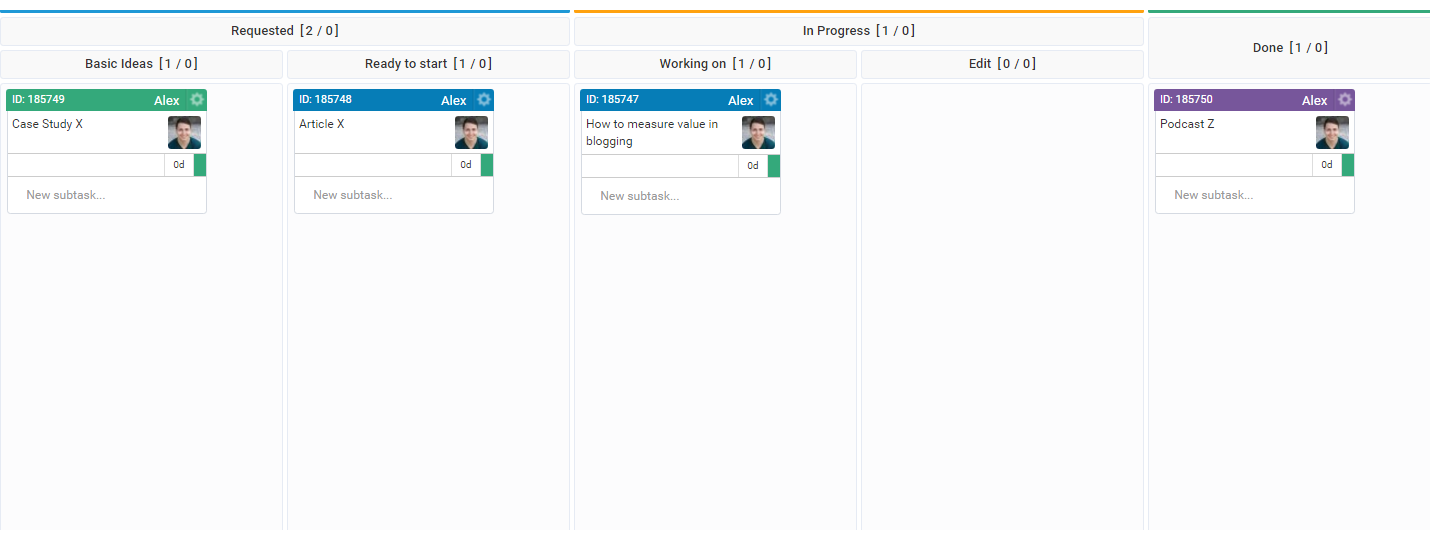
More recently, the Kanban method, typical to the IT and manufacturing industries, has been making its way into the lives of a growing number of professional writers, especially those that specialize in technical blogging. The method began in production, was later adapted for software development, and eventually, started gaining popularity in other professional fields.

It is used to map the workflow of a person or a team on a white board. Each part of the white board represents a typical step of your process, whatever it may be. Tasks are hosted on individual sticky notes that move from the first stage, on the left side of the board, to the final completion stage, on the right side of the board. On the board, you can create a backlog that contains all of the ideas that you generate, but are unable to work on at the moment.

The great thing about Kanban is that it is very simple to apply and yet extremely effective in boosting the efficiency of your creative process because it removes the possibility to lose track of your work and helps you avoid multitasking.
How to Create Consistently Valuable Content for Your Blog | ProBlogger.net

Blogging is a calling, a passion, an art, and a profession for many people across the globe. Creating value should be the main goal of every person who wants to turn their blogging from a hobby into a profession. Learning how to recognize and measure it is of utmost importance to every “pro” out there. Hopefully, by reaching the conclusion of this article, you have been able to find value in this article as well.

Alexander Novkov is Marketing Expert at Kanbanize where he specializes in content marketing and social media. Before getting into the tech world he was an economic reporter for the Bulgarian media OFFNews. Alex is passionate about creative writing and continuous improvement.

The post How to Create Consistently Valuable Content for Your Blog appeared first on ProBlogger.


from
http://feedproxy.google.com/~r/ProbloggerHelpingBloggersEarnMoney/~3/x17mMXWuUsM/

4 things I Learnt as a Blogger Working at an Influencer Marketing Platform

4 things I Learnt as a Blogger Working at an Influencer Marketing Platform

This is a guest contribution from Sam Wright at techgirlblog.com

I’d had my technology lifestyle blog for little over a year when I began working with an influencer marketing platform, connecting brands and bloggers on sponsored collaborations.

Blogging in my region hadn’t become a true income source yet (that has changed in recent months and I like to think I had something to do with it) and a solid nine-to-fiver seemed the “safe” bet, especially as the platform would let me continue my blog.

One year on, I’ve had my job title change almost bi-monthly, I’ve stood in boardrooms and fought, almost to the point of tears, for bloggers, and I’ve also stood in boardrooms and been let down, almost to the point of tears, by bloggers.

The business of blogging is evolving at a rapid pace and I’ve been lucky enough to wear both “hats”, that of the creator and that of the brand on the other side, fearfully giving up creative control of their identity to a blogger.

Playing these dual roles has taught me four key lessons that I now apply to my blog and my job. These insights have allowed me to better monetise my own platforms but also given me the ability to ensure income for other creators. These are my learnings and whether blogger or brand, I’m hoping they can assist you as much as they have me!

Content. Content. Content.

It seems like such a cliche but the truth is everything links back to the content you produce.

Good content builds your audience and invites engagement, which then makes you attractive to brands – who then become interested in paying you to create good content in order to get exposure for their product or service.

Creating great content isn’t rocket science but there are a few additional things I’ve learnt over the years. The first is that good content is subjective. I’ve seen things produced by other creators and thought: “what the hell is that?” and yet it has gone on to do incredibly well with their audience. I’ve also seen really bad content that has little to no creative flair that gets published, getting no response from the targeted audience and yet the brand is over the moon because they liked it.

Sometimes it is hard, as a blogger, to remember that you don’t create content for brands but for your audience. It shouldn’t be hard, but it can be. I have a day job, so for my blog it is easy for me to say no to something that doesn’t sit with me, but I know that when your livelihood depends on the income your little space on the internet derives, it could be easy to think you could twist the content to work. You can’t. You shouldn’t. Don’t do it. All the money in the world won’t make up for the audience you’ll lose down the line.

As a creator myself I can say this with confidence: that audience means more to you than anything and if you’re true to your craft you’ll happily penny pinch to retain them. Long term it will mean less penny pinching because you’ll be far more respected than the blogger who chose to make the quick buck along the way.

photo-1434626881859-194d67b2b86f

Report on EVERYTHING

Vanity stats, the stuff you think no one cares about and then the extra statistics you don’t even understand – make sure they all go in your closing report.

My biggest learning from a blogger’s perspective after my first year at an influencer marketing platform has been that sometimes the blogger in me gets far too caught up in the creative.

The business of blogging has two parts: Blogging and Business. Business needs a return on investment. Lots of eyeballs on some gorgeous flat lays isn’t enough and, in time, we’re going to see even the best creators fall away if they don’t begin to show an accurate conversion. Your blog post or Instagram photo is simply one section of a giant funnel leading the consumer to the point of sale.

Bloggers, when approached to work with brands, need to ask what the goal is and what the measurement criteria is going to be. Don’t do the job if you don’t think you can deliver – and when delivery time comes be sure to over-deliver: track links, track audience demographics, track the keywords they searched to get to the post you wrote. Every little detail is like a tiny golden nugget for a brand attempting to not only target the right consumer but also lead them to a point where they purchase a product.

I’m about to be a little bit controversial now but if I take off my influencer marketing hat for a minute and put on my blogger hat: I know how annoying influencer marketing platforms can be.

I realise that they constantly hound you to sign up with no real promise of reward. I know you think they take the power out of your hands. I feel you. But the truth is, these platforms offer a service to the brand on the other side that bloggers have failed at: they know how to accurately report on a campaign.

Rather than fighting ten bloggers to get any sort of statistic other than “it got 20,000 views”, “there were 35 likes”, “my monthly uniques are…” it is far easier for a brand to pay a fee to a platform to pull the data they need to build their digital campaigns. The truth is we, as bloggers, are selling ourselves short and not delivering on the costs associated with running content on our blogs.

Report on ALL. THE. THINGS.

Blogging is about community – start collaborating

Sometimes during the hunt for money to put food on our table or the obsessive need with growing our platforms I think we forget why we started blogging in the first place. I think we forget that we wanted to have a space to share with like minded people who think like us or feel like us or could relate to us in some sort of way. We forget the conversations with our friends that revolved around theme design or the concept art behind our latest blog.

You’ll notice that most influencer marketing campaigns usually involve more than one blogger or creator. That’s because a few bloggers reach a far larger target market than just one. I’ve learnt to take the business thinking and apply it to my blogging. Working with other bloggers on projects (even ones that don’t make me money) allows me to reach a new audience who might potentially be interested in my blog. It also allows the other blogger to reach my audience. Most importantly though? It makes me happy.

Even if you want to make your blog a fully-fledged business, it should still make you happy. It takes so much of your energy to create, it’s important you enjoy it. I enjoy working with other creatives (usually far better than me at what they do) because I am able to learn so much from what they do and how they work. There’s a reason we flock to a site like ProBlogger and it is because the only people who really understand the passion that goes into maintaining a blog are other bloggers.

It comes down to relationships

In one year I’ve had the opportunity to work with some of the biggest brands in the world. I’ve collaborated with some of the most well respected international media and advertising agencies both on my blog and at the influencer marketing platform I work at.

My boss is going to want me to tell you it is because of our amazing technology and the blogger in me wants to say it is because of the incredible, but small, audience I’ve built. There is no doubt that those things play a big role but I’m pretty sure there is one defining factor across that board that results in success: good relationships are built on a foundation of trust.

My blog readers trust me and because they trust me they come to me for advice or read my content for assistance. My “day job” clients trust me when I suggest our tech to better manage their influencer campaigns and report on them because I’ve been able to prove it delivers on what I say it does. My “blogging” clients trust me to look after a brand they’ve cherished, nurtured and built because they trust me (sometimes blindly). Those relationships aren’t made overnight. They’re like any other relationship and take time to nurture.

The first three things I learnt all link directly to the relationships you build: be it with other bloggers, your audience, with brands or even with the influencer marketing platform you might decide to sign up to.

In my time juggling hats I’ve realised the importance of people and of the connections we’re able to make. Ironically, the need to make those connections was the reason I started blogging in the first place.

Sam Wright is a lifestyle technology blogger at techgirlblog.com. She also heads up the software partners division at Webfluential – an influencer marketing technology company. 

The post 4 things I Learnt as a Blogger Working at an Influencer Marketing Platform appeared first on ProBlogger.


from
http://feedproxy.google.com/~r/ProbloggerHelpingBloggersEarnMoney/~3/8lDXXkDBT-I/

Tuesday, November 29, 2016

Increasing Your Completion Rates – How to Get Participants to Finish Your Course

Increasing Your Completion Rates - How to Get Participants to Finish Your Course

From ProBlogger Expert Sam Nordberg.

Online courses are all the rage right now, but sadly, there are some staggering figures when it comes to completion… and not in a good way.

Seth Godin shared on Tim Ferriss’s podcast once that most online courses have a drop off rate of 97%, and even his own courses have a drop off rate of 80%.

80%?! That means that only 20% of the people who sign up for the course actually get through to finishing it.

The thing is, Seth is not alone though.

Studies over the years show that completion rates of online courses are traditionally very low. Here in Australia, Government Statistics showed that just 7% of students who used the VET FEE-HELP loan system, completed their course between 2010 and 2013.

Yes, just 7%.

With all of that in mind, it is important to take some time when planning your course, to consider how you can help your particpants complete it.

Why would you want to increase your completion rates?

Participants who complete your course in full (and with that, implement along the way) are going to get much better results than those who drop out after just the first couple of modules. You get the satisfaction of watching them take what you have taught them, and use it to make changes to their life in some way.

That’s a pretty good reason to want to increase your completion rates.

PLUS

Better results for your participants means better word of mouth referrals for you, an increased number of people sharing your course and better testimonials.

And this in turn, leads to better sales for your next intake.

All good things, right?

Increasing your participants’ completion rate isn’t just great for you participants (they actually learn something and get good results) but it’s better for your business.

So how do you increase your completion rates?

Lack of motivation, life getting in the way, getting stuck somewhere, and feeling like they are all alone are some of the key reasons why participants might purchase a course and then never get around to completing it.

With those things in mind, below are just some of the strategies you can look at increasing completion rates for your courses. You don’t need to use all of these. Instead you can go through and select the methods that best suit your course and your participants.

  • Break the content into tiny steps
    Overwhelm can be a key component to students giving up on a course. They see the amount of work they should do, or the sheer scale of things that they have to learn, and decide (even subconsciously) that it is all far too much work.
    Make sure that you break all your content down into tiny little steps, so that each step is easily actionable, and participants can get small wins quickly.
  • Drip feed the content
    Another way to help reduce that sensation of overwhelm, is to drip feed your content to your participants. This means only giving them access to one bit at a time, with content released each day, week or month depending on your course.
    While this helps to reduce overwhelm, it also stops those who are doing well from pushing through faster, which can be a bad thing.
  • Drip fed email support
    If you are going to provide all of the content up front, consider drip feeding email support instead. This can be an automated series of emails that touches base with the participant, reminding them of where they should be up to by now, and what support is available to them if they get stuck.
  • Include less content
    One of the most common problems I see when people are creating their own courses, is in their desire to give massive value and over deliver, they send huge amounts of content out.
    More content isn’t always the best way to help your participants… in fact, less really is more.
    Focus on sending smaller bits of content that are easily actionable, rather than feeling the need to send them everything you know.
  • Get them to take action as they go
    Have you ever put something off? And the longer you put it off, the bigger the task seems?
    The same is true for your audience. This content is new to them, and possibly a little scary. The longer they wait to take action and implement, the worse it is going to seem.
    Every time you send out little tiny steps, get them to take action and implement.
  • Increase they ways they can engage with each other
    Online learning can be lonely, but it doesn’t have to be. Allowing your participants to get to know each other gives them a real sense of community, an opportunity to connect with each other, and even support each other through the course.
    This engagement can come in many forms, including group calls, a forum or even a private social media support group.
  • Increase the support on offer to them
    Sometimes people just need help. Simple as that.
    This support might come in the form of Q and A sessions, coaching calls, emails, phone calls, or even just questions answered in a forum.
    Make sure your participants know how much support they have available to them and make it easy to find.
  • Badges or certificates for each module We all like the feeling of instant gratification. Rewarding your participants at the end of each module or activity can be a great way to keep them motivated, especially if it is a long course. This could come in the form of badges which unlock on their profile, based on how much they have completed so far, or even just downloadable certificates for important modules.
  • Certificates on completion
    Sometimes, it’s all about the paperwork. This is especially true when your participants are studying towards something specific, such as a certification or recognised role.
    It doesn’t have to be that formal though. YouTube issue certificates to people who complete courses within their Creator Academy. It gives you a nice feeling, something to show off, and a reason to start and work towards the end of the next course.
  • Surprise bonuses along the way
    Working towards something that you know is there, is all well and good, but isn’t it nice to be surprised along the way? Look at ways in which you can reward those who are particularly active, who engage and who implement. This could be automated, for example, everyone who gets to the end of module 2 gets a reward they weren’t expecting.
    Or this could be spontaneous, such as a reward in your Forum or support group for someone who has gone above and beyond.

Online courses don’t have to have terrible completion rates. Using a combination of different strategies and methods is the best way to help your participants get the results they wanted when they first signed up for your course.

Are you using any of these?
Got any other ideas for helping increase your completion rates?

I’d love to hear from you.

Sam Nordberg shows people how to take their passion and knowledge and create an online course that sells. You can learn more about her here and connect with her on Facebook and Twitter.

The post Increasing Your Completion Rates – How to Get Participants to Finish Your Course appeared first on ProBlogger.


from
http://feedproxy.google.com/~r/ProbloggerHelpingBloggersEarnMoney/~3/A4YSa33khUg/

Sunday, November 27, 2016

Community Discussion: Guest Post Pitching Strategies

ProBlogger Community Discussion: Guest Post Pitching Strategies

As the editor of ProBlogger for the last three years, you can imagine I’ve seen every. pitch. ever. when it comes to guest posting.

The most I see (and immediately delete) are the ones that are copied and pasted straight from a template, with a couple of ProBlogger links inserted, and obviously emailed to all and sundry in the hopes something might be successful.

Things I often see that are a complete turnoff:

  • Pitching to “webmaster”
  • Starting with “I recently stumbled across your blog” – I can’t be sure you’ll write a great post tailored to our audience if you haven’t bothered to read our blog or get familiar with it first
  • Writing “I really enjoy reading your blog http://www.problogger.net/” – I know our URL! Including it in your pitch isn’t necessary
  • Telling me you’ve read a post on x topic on our site, but it was missing a few things and you’ve magically written a better one and did I want to post it? No thanks!
  • Poor spelling, grammar or otherwise unfamiliar with English
  • Wanting to post solely to get backlinks to your site without offering any kind of useful content for our readers

Honestly, I could go on and on.

On the flip side, I’ve seen some fantastic pitches that make me feel like I’m talking to a real person, who cares about our site and wants to produce a mutually-beneficial transaction. They’ve taken the time to read and get to know us, and have made the effort to tailor the pitch appropriately. Their ideas are well-thought-out and genuine. These pitches make me happy.

We’ve written over the years on guest posting and how to do it well (because when it’s done well, it can do wonders for your brand awareness and your traffic). Posts like How I Turned a Guest Post into 3 Million Visitors and Over 150,000 Social Media SharesGrow Traffic to Your Blog Through Guest Posting and Creating Content for Other Blogs, Forums, Media and Events, 5 Ways to Creatively Brainstorm Guest Post Ideas, and alllll of these. We teach you how to do it the right way with posts like: Why You Have a Better Chance of Landing a Guest Post Than You Think (and How to Do It)Are You Making These Mistakes With Your Guest Posts?Looking to Guest Post on Authority Sites? Here’s How to Find the Best Blogs. Guest posting can’t just be dialled in, but it doesn’t have to be impossible.

We all love hearing success stories though, so decided to ask where you’ve guest posted and what was it about your pitch that got you over the line? What has been the result of your guest posting on bigger sites in your niche? What would you recommend to newbie bloggers just starting out with guest posting?

The post Community Discussion: Guest Post Pitching Strategies appeared first on ProBlogger.


from
http://feedproxy.google.com/~r/ProbloggerHelpingBloggersEarnMoney/~3/I4gIH2-YkOk/